Revista Del Cine Español Nº 176 MARZO 2011 4 €
Total Page:16
File Type:pdf, Size:1020Kb
Load more
Recommended publications
-
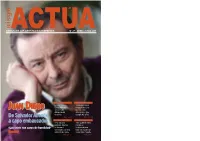
Juan Diego Juan Diego
aisge REVISTAACTUA DE LOS ARTISTAS E INTÉRPRETES Nº 27 • ABRIL/JUNIO 2011 I FISAHARA I I MARTIN PATINO I El cine como ‘Canciones para UUAANN IIEEGGOO fugaz halo de luz después de una JJ DD en la cruda guerra’, una diáspora del «liberación» que desierto cumple 40 años DeDe SalvadorSalvador AllendeAllende PÁGS. 6 A 11 PÁGS. 12 Y 15 I I. GABILONDO I I MARIVÍ BILBAO I aa capocapo embaucadorembaucador «Por razones «Me gustaría haber políticas, algunos nacido en «Las crisis son curas de humildad» se toman a Hollywood para cachondeo carreras bajar las escaleras PÁGIINAS 46 Y 47 artísticas de años» como Dios manda» PÁGS. 26 Y 27 PÁGS. 56 Y 57 2 ACTÚA I DESCUENTOS Y BENEFICIOS I I EN ESTE NÚMERO I ACTÚA 3 ENERO/MARZO ENERO/MARZO 2011 aisge REVISTA CULTURAL REVISTA CULTURAL aisge 2011 I DESCUENTOS Y BENEFICIOS I Gutiérrez Aragón Filmotecas 64 La CNC ÓPTICA ROMA PROMESCENA 4 Uno de los grandes directores de la 18 Galicia y Euskadi inauguran esta ofrece a todos los ofrece descuen- historia del cine español testimo- El director general de AISGE, Abel Martín, ana- nueva serie sobre los espacios que socios pertene- tos en artes nia su relación con los actores, liza las relaciones de la entidad con este orga- custodian la memoria de nuestros cientes a AISGE un 30% de descuento escénicas y ocio “una señal en el tiempo, un antes nismo regulador: desencuentro en torno a la grandes intérpretes del pasado siglo INSTIMED. Los socios de AISGE y fa- en gafas graduadas completas y en len- en Madrid. -

Goodbye Cinema, Hello Cinephilia Other Books by Jonathan Rosenbaum
Goodbye Cinema, Hello Cinephilia Other Books by Jonathan Rosenbaum Rivette: Texts and Interviews (editor, 1977) Orson Welles: A Critical View, by André Bazin (editor and translator, 1978) Moving Places: A Life in the Movies (1980) Film: The Front Line 1983 (1983) Midnight Movies (with J. Hoberman, 1983) Greed (1991) This Is Orson Welles, by Orson Welles and Peter Bogdanovich (editor, 1992) Placing Movies: The Practice of Film Criticism (1995) Movies as Politics (1997) Another Kind of Independence: Joe Dante and the Roger Corman Class of 1970 (coedited with Bill Krohn, 1999) Dead Man (2000) Movie Wars: How Hollywood and the Media Limit What Films We Can See (2000) Abbas Kiarostami (with Mehrmax Saeed-Vafa, 2003) Movie Mutations: The Changing Face of World Cinephilia (coedited with Adrian Martin, 2003) Essential Cinema: On the Necessity of Film Canons (2004) Discovering Orson Welles (2007) The Unquiet American: Trangressive Comedies from the U.S. (2009) Goodbye Cinema, Hello Cinephilia Film Culture in Transition Jonathan Rosenbaum the university of chicago press | chicago and london Jonathan Rosenbaum wrote for many periodicals (including the Village Voice, Sight and Sound, Film Quarterly, and Film Comment) before becoming principal fi lm critic for the Chicago Reader in 1987. Since his retirement from that position in March 2008, he has maintained his own Web site and continued to write for both print and online publications. His many books include four major collections of essays: Placing Movies (California 1995), Movies as Politics (California 1997), Movie Wars (a cappella 2000), and Essential Cinema (Johns Hopkins 2004). The University of Chicago Press, Chicago 60637 The University of Chicago Press, Ltd., London © 2010 by The University of Chicago All rights reserved. -

Premis Goya 2000 -2020
PREMIS GOYA 2000-2020 Vint-i-un anys no són res... L'Acadèmia de les Arts i les Ciències Cinematogràfiques d'Espanya és una associació sense ànim de lucre composta per professionals dedicats a les diferents especialitats de la creació cinematogràfica. L'Acadèmia celebra la qualitat del cinema espanyol amb el lliurament dels Premis Goya als millors professionals de cadascuna de les especialitats tècniques i creatives. Al llarg de la seva història, l'Acadèmia ha reconegut amb el Goya, o amb la seva nominació, el treball tant de tècnics, professionals anònims per al gran públic, com de grans estrelles espanyoles i foranes. Fem un repàs a continuació dels films que han guanyat el guardó a "millor pel·lícula" durant els últims vint-i-un anys. Incloem els enllaços al catàleg per si voleu fer reserva i també la puntuació que els han donat els usuaris de dues de les millors pàgines de cinema. 20 00 Direcció PEDRO ALMODÓVAR Intèrprets Cecilia Roth, Marisa Paredes, Penélope Cruz, Candela Peña, Antonia San Juan, Rosa María Sardà, Fernando Fernán Gómez, Fernando Guillén, Toni Cantó, Eloy Azorín, Carlos Lozano, Cayetana Guillén Cuervo Una infermera argentina que viu a Madrid i està destrossada per la mort del seu fill en un accident, es trasllada a Barcelona per parlar amb el pare del noi. Buscant l'home que la va abandonar coneixerà diferents dones que canviaran la seva vida. :7,1 :7,8 20 01 Direcció ACHERO MAÑAS Intèrprets Juan José Ballesta, Pablo Galán, Manuel Morón, Alberto Jiménez, Ana Wagener, Nieve de Medina, Gloria Muñoz, Javier Lago, Soledad Osorio, Máximo Jiménez La família de Pablo "El Bola" és una família trista, marcada per la mort del germà de Pablo. -

XXV PREMIOS GOYA 2011 25Th GOYA AWARDS 2011
XXV PREMIOS GOYA 2011 Concedidos por la Academia de las Artes y las Ciencias Cinematográficas de España 25th GOYA AWARDS 2011 By the Academy of Motion Picture Arts and Sciences of Spain Mejor Película/Best Film: "Pan Negro" © Ministerio de Cultura Isona Passola. Mejor película. Agustí Villaronga David Pinillos Mejor Dirección/Best Director: Agustí Villaronga, por “Pan Negro” Mejor Dirección Novel/Best New Director: David Pinillos, por “Bon appétit” Agustí Villaronga Rodrigo Cortés recoge el Goya de Chris Sparling Mejor guión original/Best Screenplay - Original: Chris Sparling, por “Buried" Mejor guión adaptado/Best Screenplay - Adapted: Agustí Villaronga, por “Pan Negro” Mejor Interpretación masculina protagonista/Best Actor: Javier Bardem, por “Biutiful” Mejor Interpretación femenina protagonista/Best Actress: Nora Navas, por “Pan Negro” © Ministerio de Cultura Javier Bardem Nora Navas Mejor Interpretación masculina de reparto/Best Supporting Actor: Karra Elejalde, “También la lluvia” Mejor Interpretación femenina de reparto/Best Supporting Actress: Laia Marull, por “Pan Negro” Laia Marull Karra Elejalde © Ministerio de Cultura Francesc Colomer Marina Comas Mejor actor revelación/Best New Actor: Francesc Colomer, por “Pan Negro” Mejor actriz revelación/Best New Actress: Marina Comas, por “Pan Negro” Cristina Zumárraga Antonio Riestra Alberto Iglesias Mejor dirección de producción/Best Production Supervision: Cristina Zumárraga, por “También la lluvia” Mejor fotografía/Best Cinematography: Antonio Riestra, por “Pan Negro” Mejor música -

La Vida Secreta De Las Palabras, Galardonada Con El XI Premio Cinematográfico José María Forqué
EGEDA BOLETIN 42-43 8/6/06 11:44 Página 1 No 42-43. 2006 Entidad autorizada por el Ministerio de Cultura para la representación, protección y defensa de los intereses de los productores audiovisuales, y de sus derechos de propiedad intelectual. (Orden de 29-10-1990 - B.O.E., 2 de Noviembre de 1990) La vida secreta de las palabras, galardonada con el XI Premio Cinematográfico José María Forqué Una historia de soledad e incomunicación, La vida secreta de las palabras, producida por El Deseo y Mediapro y dirigida por Isabel Coixet, ha sido galardonada con el Premio José María Forqué, que este año ha llegado a su undécima edición. En la gala, celebrada en el Teatro Real el 9 de mayo, La vida secreta de las palabras compartió homenaje con el documental El cielo gira, que se llevó el IV Premio Especial EGEDA, y con el productor Andrés Vicente Gómez, galardonado con la Medalla de Oro (Foto: Pipo Fernández) (Foto: de EGEDA por el conjunto de su carrera. La gala tuvo como maestros de ceremo- cida por Maestranza Films, ICAIC y Pyra- vertirán a los creadores españoles en los nias a Concha Velasco y Jorge Sanz, y con- mide Productions, y dirigida por Benito más protegidos de Europa. tó con la actuación musical del Grupo Sil- Zambrano; Obaba, producida por Oria ver Tones, que interpretó temas de rock Films, Pandora Film y Neue Impuls Film, y Por su parte, el presidente de EGEDA, En- and roll de los años 50 y 60. Esto supone dirigida por Montxo Armendáriz, y Prince- rique Cerezo, entregó la Medalla de Oro una novedad en el escenario del Teatro sas, producida por Reposado PC y Media- de la entidad al veterano productor An- Real, pues es la primera vez que acoge este pro, y dirigida por Fernando León de Ara- drés Vicente Gómez en reconocimiento “a género musical. -

Rafael Gil Y Cifesaenlace Externo, Se
Cuerpo(s) para nuestras letras: Rafael Gil y CIFESA (1940-1947) José Luis Castro de Paz Catedrático en la Universidad de Santiago de Compostela Texto publicado como introducción del libro: Rafael Gil y CIFESA, Filmoteca Española-Ministerio de Cultura, Madrid, 2007 Cuerpo(s) para nuestras letras: Rafael Gil y CIFESA (1940-1947) Para mis hijas, Beatriz y Alejandra Cuando empecé a hacer cine, pude realizar el cine con el que siempre había soñado. Leía a Galdós, a Unamuno, o a Fernández Flórez y pensaba: ‘¡Qué gran película hay aquí!’. Por eso mis primeras películas son cuentos de Fernández Flórez, de Alarcón, de Jardiel Poncela, etc. Rafael Gil 0. Introducción. Los inicios cinematográficos de Rafael Gil. La administración y el cine después de la Guerra Civil. Nacido el 22 de mayo de 1913 en el Teatro Real de Madrid, del que su padre licenciado en filosofía y letras, abogado y catedrático de latín era conservador, y acostumbrado al ambiente artístico y cultural desde muy joven, Rafael Gil estudia bachillerato en el Colegio de San José, integrado en el Instituto de San Isidro, donde desarrolla una juvenil pero ya profunda afición a la literatura y al cine. Crítico desde muy temprana edad tras serle aceptados los primeros textos que envía a la revista Gran Sport en 1930, publicará artículos sobre cinematografía y críticas de estreno tanto en periódicos (Campeón, 1933-34; La Voz 1931-32; ABC, 1932-36) como en las más importantes revistas especializadas durante la II República (Popular Films, Films Selectos, Nuestro Cinema), sin faltar tampoco asiduas colaboraciones radiofónicas y una no menos activa labor de organizador y difusor de actividades cinematográficas. -

El Futur No Està Escrit Nova Economia, Nova Ocupació
El futur no està escrit Nova economia, nova ocupació. El pla “Nova economia, nova ocupació” és una estratègia per a la creació de 300.000 nous llocs de treball en quatre anys. Es tracta d‘una proposta rigorosa, ambiciosa, possibilista i quantificada. estratègia “Nova economia, nova ocupació” es basa La plena ocupació com a horitzó a mitjà termini en el desenvolupament de les oportunitats que ofe- Es tracta d’un proposta rigorosa L’reix l’economia verda i de les polítiques socials i pro- S’han establert uns objectius a quatre anys. En moure la transició cap a un model socialment just i ecolò- una perspectiva a mitjà termini d’assolir la plena i ambiciosa que implica la gicament sostenible. Així com també potenciar l’ocupació ocupació, és possible rebaixar la taxa d’atur en gai- femenina en els sectors ambientals i de l’energia. Una rebé 10 punts durant la propera legislatura i aproxi- creació de fins a 300.000 llocs estratègia orientada, per tant, a l’equitat de gènere i a la mar-nos a la taxa existent l’any 2007, abans de la de treball al llarg d’aquesta millora de la participació de la dona al mercat de treball. crisi. Davant de la realitat de la destrucció d’ocupació a legislatura. Catalunya, no hi ha dubte que el principal indicador de Més ocupació i de més qualitat, més Estat de Benestar la sortida de la crisi serà la creació de llocs de treball de i més equitat. I, finalment, significa orientar el nostre país cap a qualitat. -

Media Alert: Flickers Partners with Roger Williams University to Present Spring Film/Speaker Series on the Jewish Experience Free Program Sponsored by the Edwin S
For details, art or photos about FLICKERS media releases, contact Shawn Quirk, [email protected] ⎯⎯⎯⎯⎯⎯⎯⎯⎯⎯⎯⎯⎯⎯⎯⎯⎯⎯⎯⎯⎯⎯⎯⎯⎯⎯⎯⎯⎯⎯⎯⎯⎯⎯⎯⎯⎯⎯⎯⎯⎯⎯⎯ PHOTOS AVAILABLE UPON REQUEST: MEDIA ALERT: FLICKERS PARTNERS WITH ROGER WILLIAMS UNIVERSITY TO PRESENT SPRING FILM/SPEAKER SERIES ON THE JEWISH EXPERIENCE FREE PROGRAM SPONSORED BY THE EDWIN S. SOFORENKO FOUNDATION WHAT: The Jewish Experience Program at the 13th Annual Roving Eye International Film Festival WHEN: April 17, 19 & 22, 2018 WHERE: Feinstein College of Arts and Sciences, CAS 157 and Global Heritage Hall, Room 01, Roger Williams University, 1 Old Ferry Road, Bristol, RI WHO: Flickers’ Rhode Island International Film Festival (RIIFF) and Roger Williams University (RWU) HOW MUCH: This is a Free Event WHY: To Celebrate The Jewish Experience Through The Art of International Filmmaking. Roger Williams University (RWU) has partnered with the Flickers’ Rhode Island International Film Festival (RIIFF) to present its Spring-edition of the bi-annual Roving Eye International Film Festival. The popular and acclaimed Festival celebrating global cinema and artists, announces its 2018 Spring sidebar program on The Jewish Experience through short films, documentary, media and guest speakers. This year’s Jewish Experience theme is “ARTS AND CULTURE: Storytelling Through Time,” and is presented by a grant from the Edwin S. Soforenko Foundation. The event takes place April 17, 19 & 22nd. This year’s programming explores representations of the Jewish experience in Israel, across the globe and the Holocaust through 12 premiere films, including sneak peeks of films that will play the Rhode Island International Film Festival in August. The series is hosted by the Rev. Nancy Hamlin Soukup, University Multifaith Chaplain at RWU and includes a presentation by Holocaust survivor, Sami Steigmann; and a conversation with Chris Sparling filmmaker /screenwriter. -
Filmoteca Española
15 septiembre / 12 noviembre 2016 Jueves 15, 17.30 / Sábado 17, 19.30 h Don Quijote de la Mancha España 137 min. 35 mm. septiembre Productora El viejo hidalgo Alonso Quijano, enloquecido por Compañía Industrial del la lectura de libros de caballerías, decide hacerse Film Español (CIFESA) armar caballero y abandonar su aldea en busca de Director aventuras acompañado de Sancho Panza, que se Rafael Gil convierte en su fiel escudero. Tras una serie de des- graciadas peripecias, sus amigos intentan hacerle Intérpretes volver a casa para que entre en razón. Rafael Rivelles La adaptación del Quijote realizada por CIFESA Juan Calvo en 1947 coincide con la celebración del cuarto Sara Montiel centenario del nacimiento de su autor. Y así parece Fernando Rey que el conocimiento de la novela, entre nosotros, va Manolo Morán fraguándose a golpe de conmemoraciones. Se hacía Guillermo Marín necesario, en aquella ocasión, paliar el olvido que la Francisco Rabal gran novela había sufrido en el cine español hasta la Música fecha. Y se encuentra el camino, sintetizando las dos Ernesto Halffter partes en una superproducción costosa y de metraje Fotografía dilatado. En consecuencia, la adaptación corrió a Alfredo Fraile cargo de la compañía cinematográfica española más representativa y la más afín ideológicamente al régimen franquista: CIFESA. Jueves 15, 20.00 / Viernes 16, 18.00 h Miguel & William 2007. España 101 min. 35 mm. Productora Leonor de Vibero, hija de un comerciante español ZEBRA PRODUCCIONES instalado en Inglaterra, es una joven curiosa y Directora apasionada por el teatro, pero debe regresar a Inés París Castilla para contraer matrimonio con un duque viudo y tan rico como poderoso. -
Introduction: Approaching Performance in Spanish Film
Introduction: approaching performance in Spanish film Dean Allbritton, Alejandro Melero and Tom Whittaker The importance of screen acting has often been overlooked in studies on Spanish film. While several critical works on Spanish cinema have centred on the cultural, social and industrial significance of stars, there has been relatively little critical scholarship on what stars are paid to do: act. This is perhaps surprising, given the central role that acting occupies within a film. In his essay ‘Why Study Film Acting?’, Paul McDonald argues that acting is not only crucial to understanding the affective charge of mov- ies, but integral to the study of film as a whole (2004: 40). Yet, despite its significance, performance remains one of the most elusive and difficult aspects of film analysis. One of the reasons for this, according to Pamela Robertson Wojcik, is its apparent transparency (2004: 1). A ‘good’ actor supposedly renders their performance ‘invisible’, thereby concealing the process of acting from the audience, and engaging us within the emo- tional universe of the character. To this effect, discussion on acting is all too frequently evaluative: we think in terms of how convincing or natu- ralistic a given performance is, or are invited to appreciate the actorly skills and techniques that are brought to bear on the film. Yet, when it comes to writing about performance academically, it can prove altogether more challenging. It requires us to single out and momentarily freeze the flow of specific moments of performance within a film, and to break them down to their tiniest details. We need to pay attention to what Paul McDonald has called the ‘micromeanings of the voice and body’ (2004: 40), intricately drawing out the ways in which gesture, body, facial expression and vocal delivery work together to cre- ate meaning. -

Organiza Patrocina Colabora
ORGANIZA PATROCINA COLABORA 1 AGRADECIMIENTOS AGRADECIMIENTOS GUADALUPE GALVÁN HAMPA STUDIO ADRIANA KRASOVA (CENTRO CHECO) HARDI VOLMER (OÜ NUKUFILM) ADRIENNE MICHEL-LONG HASN-GÜNTHER LÖFFLER (EMBAJADA DE ALEMANIA) ADRZEJ KLIMOWSKI HAZEL GRIAN (LICORICE FILM) ALBERTINA CARRI HILA RON (THE SAM SPIEGEL FILM & TV SCHOOL ALSIRA GARCÍA-MAROTO ISRAEL) ANA GONZALEZ (SHADOW MACHINE FILMS) INÉS GARCÍA (TNT) ANDREA ANSAREO ISABEL GRANDE (INSTITUTO CERVANTES) ANNE MARIE HARMS (DRAMATISKA INSTITUTE) ISOBEL PALOS (PARTIZAN) ANTONIO HENS XUAN ACOSTA JAN ERIK HOLST (NFI) BARBARA WOOD (TURSIMO DE IRLANDA) JASON TAMMEMAGI BARRY KELLY JAVIER BARCHÍN BEATRIZ CHAPAPRIETA (GRUPO CONSULTORES) JENNIFER KEEGAN BETTINA SCHWARZ (EUROPEAN FILMACADEMY) JEZ ALDIS BRENDAN MULDOWNEY JIM CULLEN BRIAN DURNIN JOÃO DE MELO (EMBAJADA DE PORTUGAL) CIARAN FOY JOHN CALLAGHAN CILEA MENESES JOHN HAYES CORKY QUARKENBUSH (SPACE BASS FILMS) JOHNNY O’REILLY CHAD MESERVE (LUDICROUS PRODUCTIONS) JORDAN GALLAND CHRISTIAN GUINOT (FESTIVAL DU COURT METRAGE DE JORGE SEGADO (NOTODOFILMFEST.COM) CLERMONT-FERRAND) JOSÉ ANTONIO HURTADO (IVAC) CHRISTOFFER OLOFFSON (UPPSALA INTERNATIONELLA JOSÉ MARIA DE CARVALHO (INSTITUTO CAMÕES) KORTFILMFESTIVAL) JUAN BOETA DAMON SYLVESTER KAREN WALL (REEL IRELAND) DARIO OLIVEIRO (CURTAS VILA DO CONDE) KEITH ALLAN & COURTNEY BRANCH DIANA RUMJAHN KEN WARDROP DON PORTOLESE KIERON J. WALSH EDITH PIEPERHOFF KIRSTI BAGGETHUN (EMBAJADA DE NORUEGA) EOIN RYAN LILIAN SALY (EMBAJADA DE FRANCIA) FADEL AKHAMLICH (EDITORIAL PEARSON) LORCAN FINNEGAN FILMOTECA DE CASTILLA -

Revista ACTÚA
aisge la revista trimestral de los artistas nº 58 enero/marzo · 2019 l TONI ACOSTA l JAIME BLANCH l MARÍA ISABEL DÍAZ LAGO l MANUEL GÓMEZ PEREIRA l EVA LLORACH De teleoperadora al Goya «No es que haya hecho las cosas tarde, sino a destiempo» JUAN MARGALLO «Petra y yo hemos sido generosos, y la gente lo valora» 2 enero/marzo 2019 ÍNDICE Ned cO t Ni Os FIRMAS 04 IGNACIO MARTÍNEZ DE PISÓN ‘Un sueño infantil’ 06 ANDREA JAURRIETA ‘In her solitude’ pAnoRAMA ACTÚA 08 Manuel Gómez Pereira 38 Bando sonoro: Ciclocéano Nº 58 eNero/marzo De 2019 12 Los seis de los Goya 2019 40 El localizador: Santo Domingo (Burgos) y el documental ‘Desenterrando Sad Hill’ revista cultural de aISGe • Artistas 14 Todos los premios: Asecan, Gaudí, Mestre Intérpretes, Sociedad de Gestión 42 La peli de mi vida: Lucas Vidal Mateo, María Casares, CEC, Take, ADE, edita • Fundación AISGE Simón, Unión de Actores… y Luna Miguel Depósito legal • M-41944-2004 26 Ilustres veteranos: Micky 44 Cultura LGTBI: Antes de que ISSN • 1698-6091 28 Cosecha propia: ‘Quién puede matar nos casáramos a un niño’ 46 Esta peli no la conoces ni tú. Director de la Fundación aISGe • 32 Cien años del Metro de Madrid Empezamos por ‘El ojo de cristal’ Abel Martín Coordinador del comité editorial 48 Las restauraciones de la Filmoteca 34 Webseries: Sonia Méndez • Willy Arroyo 36 Raúl Peña, por América Latina: 50 El recuerdo de Francisco Moreno Director de aCTÚa • Fernando Neira su “lugar en el mundo” 52 Muñoz Molina y los ciclos de AISGE redacción • Héctor Álvarez J.