Orchidarium Es Una Revista Editada Por El Parque Botánico Y Orquidario De Estepona
Total Page:16
File Type:pdf, Size:1020Kb
Load more
Recommended publications
-

A Review of CITES Appendices I and II Plant Species from Lao PDR
A Review of CITES Appendices I and II Plant Species From Lao PDR A report for IUCN Lao PDR by Philip Thomas, Mark Newman Bouakhaykhone Svengsuksa & Sounthone Ketphanh June 2006 A Review of CITES Appendices I and II Plant Species From Lao PDR A report for IUCN Lao PDR by Philip Thomas1 Dr Mark Newman1 Dr Bouakhaykhone Svengsuksa2 Mr Sounthone Ketphanh3 1 Royal Botanic Garden Edinburgh 2 National University of Lao PDR 3 Forest Research Center, National Agriculture and Forestry Research Institute, Lao PDR Supported by Darwin Initiative for the Survival of the Species Project 163-13-007 Cover illustration: Orchids and Cycads for sale near Gnommalat, Khammouane Province, Lao PDR, May 2006 (photo courtesy of Darwin Initiative) CONTENTS Contents Acronyms and Abbreviations used in this report Acknowledgements Summary _________________________________________________________________________ 1 Convention on International Trade in Endangered Species (CITES) - background ____________________________________________________________________ 1 Lao PDR and CITES ____________________________________________________________ 1 Review of Plant Species Listed Under CITES Appendix I and II ____________ 1 Results of the Review_______________________________________________________ 1 Comments _____________________________________________________________________ 3 1. CITES Listed Plants in Lao PDR ______________________________________________ 5 1.1 An Introduction to CITES and Appendices I, II and III_________________ 5 1.2 Current State of Knowledge of the -

South Cameroon)
Plant Ecology and Evolution 152 (1): 8–29, 2019 https://doi.org/10.5091/plecevo.2019.1547 CHECKLIST Mine versus Wild: a plant conservation checklist of the rich Iron-Ore Ngovayang Massif Area (South Cameroon) Vincent Droissart1,2,3,8,*, Olivier Lachenaud3,4, Gilles Dauby1,5, Steven Dessein4, Gyslène Kamdem6, Charlemagne Nguembou K.6, Murielle Simo-Droissart6, Tariq Stévart2,3,4, Hermann Taedoumg6,7 & Bonaventure Sonké2,3,6,8 1AMAP Lab, IRD, CIRAD, CNRS, INRA, Université de Montpellier, Montpellier, France 2Missouri Botanical Garden, Africa and Madagascar Department, P.O. Box 299, St. Louis, Missouri 63166-0299, U.S.A. 3Herbarium et Bibliothèque de Botanique africaine, C.P. 265, Université Libre de Bruxelles, Campus de la Plaine, Boulevard du Triomphe, BE-1050 Brussels, Belgium 4Meise Botanic Garden, Domein van Bouchout, Nieuwelaan 38, BE-1860 Meise, Belgium 5Evolutionary Biology and Ecology, Faculté des Sciences, C.P. 160/12, Université Libre de Bruxelles, 50 Avenue F. Roosevelt, BE-1050 Brussels, Belgium 6Plant Systematics and Ecology Laboratory, Higher Teachers’ Training College, University of Yaoundé I, P.O. Box 047, Yaoundé, Cameroon 7Bioversity International, P.O. Box 2008 Messa, Yaoundé, Cameroon 8International Joint Laboratory DYCOFAC, IRD-UYI-IRGM, BP1857, Yaoundé, Cameroon *Author for correspondence: [email protected] Background and aims – The rapid expansion of human activities in South Cameroon, particularly mining in mountainous areas, threatens this region’s exceptional biodiversity. To comprehend the effects of land- use change on plant diversity and identify conservation priorities, we aim at providing a first comprehensive plant checklist of the Ngovayang Massif, focusing on the two richest plant families, Orchidaceae and Rubiaceae. -
Orchids and I News: Hope Members Have Cake Presented to OSGB
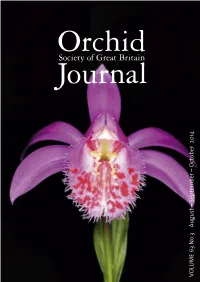
J O S o o c i e t y r u o f c G r r h e n a t B i r a i d t a i l n VOLUME 63 No 3 August – September – October 2014 The Orchid Society of Great Britain Registered Charity No. 261273 www.osgb.org.uk Officers of the Society Committee Members #President: Mr Peter White Mrs Betty Barber 61 Stanwell Lea, Middleton Cheney, Banbury, 8 Dean Close, Deeds Grove, High Wycombe, Oxfordshire, OX17 2RF Buckinghamshire, HP12 3NS Tel: 01295 712159 Tel: 01494 529604 e-mail: [email protected] e-mail: [email protected] Vice Presidents: Mrs B Arnold, Mrs J Kelleher, Mr Peter Johnson Mr T Lewis, Dr E Watson Le Touquet, Station Road, Elsenham, #Chairman: Mr Roy White Bishop’s Stortford, Hertfordshire, CM22 6LG 30 Acorn Grove, Ruislip Gardens, Middlesex, HA4 6LP Tel: 01279 812704 Tel: 01895 632689 Mobile: 07873 716496 e-mail: [email protected] e-mail: [email protected] Vice Chairman: #Secretary: Mrs Val Micklewright Mr Robert Mundell 103 North Road, Three Bridges, Crawley, 5 Elm Grove, Wivenhoe, Essex, CO7 9AY West Sussex, RH10 1SQ Tel: 01206 823777 Tel: 01293 528615 e-mail: [email protected] e-mail: [email protected] #Treasurer: Mrs Sally Mill # Trustee of the Society 82 Hazelwick Road, Three Bridges, * Delegate to the British Orchid Council West Sussex, RH10 1NH Tel: 01293 547896 #Membership Secretary: Mrs Sue Johnson Le Touquet, Station Road, Elsenham, Bishop’s Stortford, Hertfordshire, CM22 6LG Tel: 01279 812704 e-mail: [email protected] #Displays Manager: Miss Jeanette Beaney 50 Court Road, Orpington, Kent, BR6 -

Orchidaceae) from Argentina and Uruguay
Phytotaxa 175 (3): 121–132 ISSN 1179-3155 (print edition) www.mapress.com/phytotaxa/ PHYTOTAXA Copyright © 2014 Magnolia Press Article ISSN 1179-3163 (online edition) http://dx.doi.org/10.11646/phytotaxa.175.3.1 A new paludicolous species of Malaxis (Orchidaceae) from Argentina and Uruguay JOSÉ A. RADINS1, GERARDO A. SALAZAR2,5, LIDIA I. CABRERA2, ROLANDO JIMÉNEZ-MACHORRO3 & JOÃO A. N. BATISTA4 1Dirección de Biodiversidad, Ministerio de Ecología y Recursos Naturales Renovables, Calle San Lorenzo 1538, Código Postal 3300, Posadas, Misiones, Argentina 2Departamento de Botánica, Instituto de Biología, Universidad Nacional Autónoma de México, Apartado Postal 70-367, 04510 Mexico City, Distrito Federal, Mexico 3Herbario AMO, Montañas Calizas 490, Lomas de Chapultepec, 11000 Mexico City, Distrito Federal, Mexico 4Departamento de Botânica, Instituto de Ciências Biológicas, Universidade Federal de Minas Gerais, Caixa Postal 486, 31270−910 Belo Horizonte, Minas Gerais, Brazil 5Corresponding autor; e-mail [email protected] Abstract Malaxis irmae, a new orchid species from the Paraná and Uruguay river basins in northeast Argentina and Uruguay, is de- scribed and illustrated. It is similar in size and overall floral morphology to Malaxis cipoensis, a species endemic to upland rocky fields on the Espinhaço range in Southeastern Brazil, which is its closest relative according to a cladistics analysis of nuclear (ITS) and plastid (matK) DNA sequences presented here. However, M. irmae is distinguished from M. cipoensis by inhabiting lowland marshy grasslands, possessing 3−5 long-petiolate leaves per shoot (vs. 2 shortly petiolate leaves), cy- lindrical raceme (vs. corymbose), pale green flowers (vs. green-orange flowers) and less prominent basal labellum lobules. -

An Assessment of Orchids' Diversity in Penang Hill, Penang, Malaysia After
Biodivers Conserv (2011) 20:2263–2272 DOI 10.1007/s10531-011-0087-z ORIGINAL PAPER An assessment of orchids’ diversity in Penang Hill, Penang, Malaysia after 115 years Rusea Go • Khor Hong Eng • Muskhazli Mustafa • Janna Ong Abdullah • Ahmad Ainuddin Naruddin • Nam Sook Lee • Chang Shook Lee • Sang Mi Eum • Kwang-Woo Park • Kyung Choi Received: 22 September 2010 / Accepted: 3 June 2011 / Published online: 12 June 2011 Ó The Author(s) 2011. This article is published with open access at Springerlink.com Abstract A comprehensive study on the orchid diversity in Penang Hill, Penang, Malaysia was conducted from 2004 to 2008 with the objective to evaluate the presence of orchid species listed by Curtis (J Strait Br R Asiat Soc 25:67–173, 1894) after more than 100 years. A total of 85 species were identified during this study, of which 52 are epiphytic or lithophytic and 33 are terrestrial orchids. This study identified 57 species or 64.8% were the same as those recorded by Curtis (1894), and 78 species or 66.1% of Turner’s (Gar- dens’ Bull Singap 47(2):599–620, 1995) checklist of 118 species for the state of Penang including 18 species which were not recorded by Curtis (1894) and the current study but are actually collected from Penang Hill. A comparison table of the current findings against Curtis (1894) and Turner (1995) is provided which shows only 56 species were the same in all three studies. The preferred account for comparison was Curtis’ (1894) list as his report was specifically for the areas around Penang Island especially Penang Hill, Georgetown and Ayer Itam areas. -
Intergeneric Classification of Genus Bulbophyllum from Peninsular Malaysia Based on Combined Morphological and Rbcl Sequence Data
Pak. J. Bot., 48(4): 1619-1627, 2016. INTERGENERIC CLASSIFICATION OF GENUS BULBOPHYLLUM FROM PENINSULAR MALAYSIA BASED ON COMBINED MORPHOLOGICAL AND RBCL SEQUENCE DATA SH. HOSSEINI1* AND K. DADKHAH2 1Department of Biological Science and Biotechnology University of Kurdistan, Sanandaj, Iran 2Department of Statistics, Faculty of Science, University of Kurdistan, Sanandaj, Iran *Corresponding author’s e-mail: [email protected] Abstract Bulbophyllum Thou. is largest genus in Orchidaceae family and a well-known plant of tropical area. The present study provides a comparative morphological study of 38 Bulbophyllum spp. as well as molecular sequence analysis of large subunit of rubisco (rbcL), to infer the intergeneric classification for studied taxa of genus Bulbophyllum. Thirty morphological characters were coded in a data matrix, and used in phenetic analysis. Morphological result was strongly consistent with earlier classification, with exception of B. auratum, B. gracillimum, B. mutabile and B. limbatum status. Furthermore Molecular data analysis of rbcL was congruent with morphological data in some aspects. Species interrelationships specified using combination of rbcL sequence data with morphological data. The results revealed close affiliation in 11 sections of Bulbophyllum from Peninsular Malaysia. Consequently, based on this study generic status of sections Cirrhopetalum and Epicrianthes cannot longer be supported, as they are deeply embedded within the genus Bulbophyllum. Key words: Bulbophyllum, Orchidaceae, Peninsular Malaysia, rbcL Introduction Jamil et al., 2014). The structural portion of this study was performed using qualitative characters of rhizome, The largest collection of subtribe Bulbophyllinae pseudobulb, leaf and flower for 38 different species. (Orchidaceae) have been defined as Bulbophyllum, a DNA sequence data from the large subunit of rubisco genus which form a large, pantropical, and poorly studied (rbcL) which produces the carbon dioxide fixing enzyme group of orchids in Peninsular Malaysia. -
Network Scan Data
Selbyana 29(1): 69-86. 2008. THE ORCHID POLLINARIA COLLECTION AT LANKESTER BOTANICAL GARDEN, UNIVERSITY OF COSTA RICA FRANCO PUPULIN* Lankester Botanical Garden, University of Costa Rica. P.O. Box 1031-7050 Cartago, Costa Rica, CA Angel Andreetta Research Center on Andean Orchids, University Alfredo Perez Guerrero, Extension Gualaceo, Ecuador Harvard University Herbaria, Cambridge, MA, USA The Marie Selby Botanical Gardens, Sarasota, FL, USA Email: [email protected] ADAM KARREMANS Lankester Botanical Garden, University of Costa Rica. P.O. Box 1031-7050 Cartago, Costa Rica, CA Angel Andreetta Research Center on Andean Orchids, University Alfredo Perez Guerrero, Extension Gualaceo, Ecuador ABSTRACT. The relevance of pollinaria study in orchid systematics and reproductive biology is summa rized. The Orchid Pollinaria Collection and the associate database of Lankester Botanical Garden, University of Costa Rica, are presented. The collection includes 496 pollinaria, belonging to 312 species in 94 genera, with particular emphasis on Neotropical taxa of the tribe Cymbidieae (Epidendroideae). The associated database includes digital images of the pollinaria and is progressively made available to the general public through EPIDENDRA, the online taxonomic and nomenclatural database of Lankester Botanical Garden. Examples are given of the use of the pollinaria collection by researchers of the Center in a broad range of systematic applications. Key words: Orchid pollinaria, systematic botany, pollination biology, orchid pollinaria collection, -

Dendrobium (Orchidaceae): to Split Or Not to Split?
Gardens’ Bulletin Singapore 63(1 & 2): 245–257. 2011 245 Dendrobium (Orchidaceae): To split or not to split? André Schuiteman Herbarium, Library, Art and Archives, Royal Botanic Gardens, Kew, Richmond, Surrey TW9 3AE, U.K. [email protected] ABSTRACT. Dendrobium Sw. is one of the three largest orchid genera, with around 1580 species if certain currently accepted satellite genera are included. Until recently, no serious attempts have been made to split up this important genus into smaller genera. An infrageneric classification at the sectional level, largely due to Schlechter, has been accepted by most workers. Recent analyses based on DNA markers by Yukawa, Clements, and others have provided new insights into the phylogeny of Dendrobium. Their work shows that Dendrobium is not monophyletic when the satellite genera are excluded. This led to proposals to split up Dendrobium into as many as fifty genera, largely along the lines of Schlechter’s sections. However, the data do not suggest any single, evident way to do the splitting. Here it is argued that a broad concept of the genus Dendrobium, which includes genera like Cadetia Gaudich., Flickingeria A.D.Hawkes and Epigeneium Gagnep., among others, is to be preferred. The comparable cases of other large orchid genera are briefly discussed and some observations are made on character evolution in Dendrobium and the origin of the genus in light of DNA-based phylogenies. Keywords. Classification, Dendrobium, generic concepts, molecular phylogeny, Orchidaceae Introduction In its traditional, broad delimitation, Dendrobium Sw. is one of the three largest orchid genera (Cribb & Govaerts 2005: 1197 spp.) as well as one of the most important in commercial horticulture. -
Index Sorted by Title
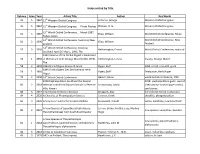
Index sorted by Title Volume Issue Year Article Title Author Key Words 31 5 1967 12th Western Orchid Congress Jefferies, George Western Orchid Congress 31 5 1967 12th Western Orchid Congress — Photo Flashes Philpott, R. G. Western Orchid Congress 12th World Orchid Conference ... March 1987, 51 4 1987 Eilau, William World Orchid Conference, Tokyo Tokyo, Japan 13th World Orchid Conference, Auckland, New World Orchid Conference, New 54 2 1990 Eilau, William Zealand Zealand 14th World Orchid Conference, Glascow, 57 3 1993 Hetherington, Ernest World Orchid Conference, scotland Scotland, April 26-May 1, 1993, The 1992 Volume of the Orchid Digest is Dedicated 56 1 1992 in Memoriam to D. George Morel (1926-1973), Hetherington, Ernest history, George Morel The 58 4 1994 1994 Orchid Digest Research Grant Digest Staff 1994 orchid, research, grant 1995 Orchid Digest Dec Dedicated to Herb 59 1 1995 Digest Staff Dedication, Herb Hager Hager 72 2 2008 19th World Orchid Conference Hersch, Helen world orchid conference, 19th 2018 Paphiopedilum Guild and the Second 2018, paphiopedilum guild, second 82 2 2018 International World Slipper Orchid Conference Sorokowsky, David international world slipper orchid, Hilo, Hawaii conference 80 3 2016 22nd World Orchid Conference Pridgeon, Alec 22nd World Orchid Conference 84 4 2020 A Checklist of Phramipedium Species Cervera, Frank checklist, phragmipedium 84 3 2020 A New Color Forma for Vanda curvifolia Koopowitz, Harold vanda, curvifolia, new color form A New Species of Lepanthes (Orchidaceae: Larson, Bruno, Portilla, Jose, Medina 85 2 2021 new species, Lepanthes, Ecuador Pleurothallidinae) from South East Ecuador Hugo A New Species of Pleurothallopsis new species, pleurothallopsis, 82 1 2018 (Epidendreae, Epidendroideae, Orchidaceae): Matthews, Luke M. -

VERHANDLUNGEN Des Naturwissenschaftlichen Vereins in Hamburg
VERHANDLUNGEN des Naturwissenschaftlichen Vereins in Hamburg NF 47 | 2013 Schriftleitung Dr. Schmidt-Rhaesa, Hamburg Sonderdruck GOECKE & EVERS Verh. Naturwiss. Ver. Hamburg NF 47 | 2013 Page 5–251 5 Matthias Schultz | Hamburg The Orchid Types of the Herbarium Hamburgense (HBG) Keywords herbarium, orchids, types Abstract An inventory of Orchidaceae type specimens kept in the Herbarium Hamburgense (HBG) of the University of Hamburg is presented. 1034 verified type specimens have been located. These represent 172 genera, 805 species and 34 infraspecific entities at subspecies (2), variety (30) or form (2) level. Additionally, 65 sheets marked as types representing 60 putatively unpublished names are listed in an appendix. Collection data as well as type status and synonyms are provided. References are made to electro- nic resources providing access to full collection metadata as well as high resolution images. Author’s Address Matthias Schultz, Herbarium Hamburgense, Biocenter Klein-Flottbek and Botanical Garden, University of Hamburg, Ohnhorststr. 18, D-22609 Hamburg, email: [email protected] 6 NF 47 | 2013 Matthias Schultz Introduction The Orchidaceae is the largest of the monocot plant families. It is cosmopolitan, but the diversity is highest in the tropics. The family comprises almost 800 genera and more than 20.000 species (Mabberley 2008). Many orchids have been – and still are – much esteemed for their showiness and the Orchidaceae is certainly one of the most important horticultural plant families. Hamburg was the “continental centre of orchi- domania” during the middle of the 19th century second only to the United Kingdom, the global centre of the exaggerated passion for orchids at that time (Poppendieck 2006). -

MICROMORFOLOGIA E ANATOMIA FLORAL DAS SEÇÕES NEOTROPICAIS DE Bulbophyllum THOUARS (ORCHIDACEAE, ASPARAGALES): CONSIDERAÇÕES TAXONÔMICAS E EVOLUTIVAS
UNIVERSIDADE ESTADUAL PAULISTA unesp “JÚLIO DE MESQUITA FILHO” INSTITUTO DE BIOCIÊNCIAS – RIO CLARO PROGRAMA DE PÓS-GRADUAÇÃO EM CIÊNCIAS BIOLÓGICAS (BIOLOGIA VEGETAL) MICROMORFOLOGIA E ANATOMIA FLORAL DAS SEÇÕES NEOTROPICAIS DE Bulbophyllum THOUARS (ORCHIDACEAE, ASPARAGALES): CONSIDERAÇÕES TAXONÔMICAS E EVOLUTIVAS ELAINE LOPES PEREIRA NUNES Tese apresentada ao Instituto de Biociências do Câmpus de Rio Claro, Universidade Estadual Paulista, como parte dos requisitos para obtenção do título de Doutor em Ciências Biológicas (Biologia Vegetal). Setembro - 2014 UNIVERSIDADE ESTADUAL PAULISTA unesp “JÚLIO DE MESQUITA FILHO” INSTITUTO DE BIOCIÊNCIAS – RIO CLARO PROGRAMA DE PÓS-GRADUAÇÃO EM CIÊNCIAS BIOLÓGICAS (BIOLOGIA VEGETAL) MICROMORFOLOGIA E ANATOMIA FLORAL DAS SEÇÕES NEOTROPICAIS DE Bulbophyllum THOUARS (ORCHIDACEAE, ASPARAGALES): CONSIDERAÇÕES TAXONÔMICAS E EVOLUTIVAS ELAINE LOPES PEREIRA NUNES Orientadora: Profa. Dra. Alessandra Ike Coan Coorientador: Prof. Dr. Eric de Camargo Smidt Setembro - 2014 581.4 Nunes, Elaine Lopes Pereira N972m Micromorfologia e anatomia floral das seções neotropicais de Bulbophyllum Thouars (Orchidaceae, Asparagales) : considerações taxonômicas e evolutivas / Elaine Lopes Pereira Nunes. - Rio Claro, 2014 252 f. : il., figs., tabs. Tese (doutorado) - Universidade Estadual Paulista, Instituto de Biociências de Rio Claro Orientador: Alessandra Ike Coan Coorientador: Eric de Camargo Smidt 1. Anatomia vegetal. 1. Anatomia floral de Orchidaceae. 3. Dendrobieae. 4. Epidendroideae. 5. Labelo. 6. Nectário. 6. Osmóforos. -

Catálogo De La Familia Orchidaceae En Guinea Ecuatorial
Collectanea Botanica 37: e003 enero-diciembre 2018 ISSN-L: 0010-0730 https://doi.org/10.3989/collectbot.2018.v37.003 Catálogo de la familia Orchidaceae en Guinea Ecuatorial P. GALÁN CELA1, R. GAMARRA2 & E. ORTÚÑEZ2 1 Departamento de Sistemas y Recursos Naturales, Universidad Politécnica de Madrid, av. de las Moreras, s/n, ES-28040 Madrid, España 2 Departamento de Biología, Universidad Autónoma de Madrid, c. Darwin, 2, ES-28049 Madrid, España ORCID iD. P. GALÁN CELA: http://orcid.org/0000-0002-5760-9509, R. GAMARRA: http://orcid.org/0000-0002-9789-1414, E. ORTÚÑEZ: http://orcid.org/0000-0002-0504-6601 Autor para correspondencia: P. Galán Cela ([email protected]) Editor: S. Garcia Recibido 2 noviembre 2016; aceptado 14 septiembre 2017; publicado on line 4 junio 2018 Abstract CHECKLIST OF THE FAMILY ORCHIDACEAE IN EQUATORIAL GUINEA.— The current state of knowledge on Orchidaceae in Equatorial Guinea is provided, based on herbarium collections and bibliographic revision. Orchidaceae are represented in Equatorial Guinea (Annobon, Bioko and Rio Muni) by 225 taxa, and 12 more requiring confirmation, belonging to 43 genera and 10 tribes of the subfamilies Vanilloideae, Orchidoideae and Epidendroideae. Eighty eight taxa have been added for Rio Muni to the previous checklists. The tribe Vandeae is the best represented with 118 taxa. Analysing the habit, 53 taxa are terrestrial, 6 scandent and 166 are epiphytes. The island of Bioko and the western provinces of Rio Muni show the major diversity in orchids. Thirty one species have been described from materials collected in Equato- rial Guinea, six of which are considered endemics.