Satsang- Exam Pragna- 1 Paper - 1
Total Page:16
File Type:pdf, Size:1020Kb
Load more
Recommended publications
-

Invaluable Books of Brahmvidya
INVALUABLE BOOKS OF BRAHMVIDYA VACHANAMRUT AND SWAMI NI VAATO 1 Table of Contents PART 1 - BRAHMVIDYA ......................................................................................................... 6 1.1 The capacity of the human-brain to learn several kinds of knowledge ............................................... 6 1.2 The importance of Brahmvidya (Knowledge of atma) .......................................................................... 7 1.3 The Imporance and the necessity of Brahmvidya .................................................................................. 8 PART 2 - VACHANAMRUT…………..…………………………………...………..…………14 2.1 The aspects of Vachanamrut and the subjects explained therein ....................................................... 15 2.1.1 The aspects of Vachanamrut ......................................................................................................... 15 2.1.2 The topics covered in the Vachanamrut are spiritual, not mundane or worldly………………………………………………………………..………………16 2.2 Essence, secrets, and principle of all the scriptures in Vachanamrut ......................................... 18 2.3 Opinions About The Vachanamrut ................................................................................................. 21 2.3.1 The opinions of the Gunatit Gurus .............................................................................................. 21 2.3.2 The opinions of prominent learned personalities ....................................................................... 22 2.4 The -

Kirtan Leelaarth Amrutdhaara
KIRTAN LEELAARTH AMRUTDHAARA INSPIRERS Param Pujya Dharma Dhurandhar 1008 Acharya Shree Koshalendraprasadji Maharaj Ahmedabad Diocese Aksharnivasi Param Pujya Mahant Sadguru Purani Swami Hariswaroopdasji Shree Swaminarayan Mandir Bhuj (Kutch) Param Pujya Mahant Sadguru Purani Swami Dharmanandandasji Shree Swaminarayan Mandir Bhuj (Kutch) PUBLISHER Shree Kutch Satsang Swaminarayan Temple (Kenton-Harrow) (Affiliated to Shree Swaminarayan Mandir Bhuj – Kutch) PUBLISHED 4th May 2008 (Chaitra Vad 14, Samvat 2064) Produced by: Shree Kutch Satsang Swaminarayan Temple - Kenton Harrow All rights reserved. No part of this book may be used or reproduced in any form or by any means without written permission from the publisher. © Copyright 2008 Artwork designed by: SKSS Temple I.T. Centre © Copyright 2008 Shree Kutch Satsang Swaminarayan Temple - Kenton, Harrow Shree Kutch Satsang Swaminarayan Temple Westfield Lane, Kenton, Harrow Middlesex, HA3 9EA, UK Tel: 020 8909 9899 Fax: 020 8909 9897 www.sksst.org [email protected] Registered Charity Number: 271034 i ii Forword Jay Shree Swaminarayan, The Swaminarayan Sampraday (faith) is supported by its four pillars; Mandir (Temple), Shastra (Holy Books), Acharya (Guru) and Santos (Holy Saints & Devotees). The growth, strength and inter- supportiveness of these four pillars are key to spreading of the Swaminarayan Faith. Lord Shree Swaminarayan has acknowledged these pillars and laid down the key responsibilities for each of the pillars. He instructed his Nand-Santos to write Shastras which helped the devotees to perform devotion (Bhakti), acquire true knowledge (Gnan), practice righteous living (Dharma) and develop non- attachment to every thing material except Supreme God, Lord Shree Swaminarayan (Vairagya). There are nine types of bhakti, of which, Lord Shree Swaminarayan has singled out Kirtan Bhakti as one of the most important and fundamental in our devotion to God. -

Pramukh Swami's Work
Pramukh Swami's Work “In the good of others lies our own...” This maxim by Pramukh Swami Maharaj is not only an inspiring call for all humanity, but also reflects the spirit of his services to man and society. Acclaimed as a unique and rare holy soul of India, Pramukh Swami Maharaj was born on 7 December 1921 in the village of Chansad, Gujarat. He is the fifth successor in the illustrious spiritual tradition of Bhagwan Swaminarayan (1781-1830) who established the Swaminarayan Sampradaya. Pramukh Swami Maharaj was born in the village of Chansad, 12 km from Vadodara in Gujarat on 7 December, 1921. Known as Shantilal in his childhood, he was wedded to devotion from a young age. His parents, Motibhai and Diwaliben Patel, were adherents of the Swaminarayan Sampradaya. Shastriji Maharaj had discerned the potential of young Shantilal from the very day he initiated him as a disciple. While studying in 6th grade, Shantilal received the call from guru Shastriji Maharaj to renounce his home. With the blessings of his parents, he left home at the age of 18 and was initiated by Shastriji Maharaj in January 1940 and was renamed as Sadhu Narayanswarupdas. For 11 years, Narayanswarupdas served under guru Shastriji Maharaj. During the initial years, he toured with him and studied Sanskrit and the shastras. He excelled in studies but had to discontinue them to serve in the mandir-building activities. In 1943, he played an important role in the construction work of the mandir in Atladra. From 1946-1950, he was given the responsibility of Kothari of the BAPS Swaminarayan Mandir in Sarangpur. -
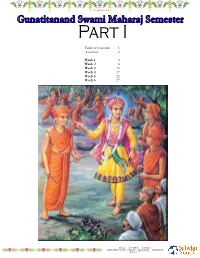
Table of Contents Aashirvād Week 1 Week 2 Week 3 Week 4 Week 5
|| Swami Shreeji || Table of Contents 1 Aashirvād 2 Week 1 3 Week 2 8 Week 3 13 Week 4 17 Week 5 22 Week 6 27 U S A Y OUTH S ABHA GUNATITANAND SWAMI MAHARAJ SEMESTER P ART I || Swami Shreeji || My dear dikrāo, Jai Swaminarayan! As you know, Yogi Bapa started this weekly sabha, and he also stressed that all children should attend every weekly sabha. Yogi Bapa and Guruvarya Param Pujya Sahebdada shower their blessings upon all of you ‘akshar muktos.’ Do you know what you are getting from attending sabha? Let me tell you… 1. You can find your identity—who you are & why Maharaj has sent you here on Earth. 2. You have the company of good people, and you can learn discipline. 3. You learn to do pooja, you practice every day, and you do it with concentration. 4. You get good grades because you learn the art of concentration. 5. You learn to love, respect, and follow your leaders, which enhances your personal development. 6. You learn humility, how to speak respectfully, and how to perform your duties, which adds to your maturity. 7. You learn the quality of leadership by learning to follow your leader. 8. You make like-minded, good friends. 9. You learn how to maintain a friendship, and you learn that friendliness is Godliness. 10. You never feel lonely, bored or depressed because you are always within a group, and by working together with many more like-minded friends you develop creativity. 11. You can be a good devotee, a good person (human being), and a good citizen. -

Satsang Pravesh Paper-1
1 2 40/200 Q.3 Answer concisely any ONE of the following. BOCHASANWASI SHREE AKSHAR PURUSHOTTAM (In 12 lines.) 4 SWAMINARAYAN SANSTHA 1. Darshan in two forms. SATSANG EXAMINATIONS 2 Ungrateful Sevakram. SATSANG PRAVESH 3. Upliftment of the Telangi Brahmin. Q.4 Answer ALL of the questions below, using only one PAPER-1 sentence for each answer. 6 th Date: 9 July 2000 1. What would Krishna Tamboli feed Neelkanth? Time: 9.00 a.m. to 11.15 a.m. TOTAL MARKS: 75 2. For how long did Neelkanth’s travels last? Note: Figures to the right indicate the marks for that question. 3. Who fed Neelkanth on Kala Parvat? SECTION - 1 4. Where was Lakshmanji given darshan in the divine (NEELKANTH CHARITRA) form of Ramchandraji by Neelkanth? Q.1 For any TWO of the following, state who is speaking 5. Who gave diksha to Ramanand Swami in his to whom and when the words were spoken. 6 dreams? And where did this take place? 1. “If you are sincere and earnest in your quest, you 6. Which marks were present on Neelkanth’s left will find God incarnate right here.” sole. 2. “Please bestow upon us the virtues of vairagya and Q.5 Narrate any ONE of the following and bring out its penance.” moral. (In 12 lines.) 4 3. “When you want to become a sadhu, come 1. Neelkanth carried the bundle of cucumbers. searching for me in Kathiyawad.” 2. The police chief in a trance. 4. “My name is Sahajanand.” 3. Meeting with Gopal Yogi. Q.2 Give reasons for any TWO of the following. -

A Religiohistorical Study Davraj Kamal Master Of
SWAMINARAYAN AND ETHICS; A RELIGIOHISTORICAL STUDY by DAVRAJ KAMAL submitted in fulfilment of the requirements for the degree of MASTER OF ARTS in the subject RELIGIOUS STUDIES at the UNIVERSITY OF SOUTH AFRICA SUPERVISOR: PROFESSOR C DU P LE ROUX NOVEMBER 1994 SUMMARY As part of the Phenomenological Method used in this dissertation, the research work applied the hermeneutical concepts of bhakti, karma and moksha. Focus was on the role played by the guru, the sadhus and devotees of the Swaminarayan Movement and how they related t~ their religious, ethical and social obligations. Their responses to ethical scriptures were evaluated, especially with a view to determining the extent to which ethical injunctions permeates, enhances, uplifts and shapes the adherents spiritually,morally and socially. Swaminarayan ethics was also placed within the context of Classical Hindu Texts and in particular, the work of Ramanuja and his Vishistadvaita philosophy. Further, it has been observed that the quest for the Ultimate Reality (Purushottam) is through their relationship with Akshar, Guru Pramukh Swami, the model of ethical excellence whose charisma binds the fibre of the Movement and his role serves both the ethical and transcendental plane of the Movement. TITLE OF DISSERTATION: SWAMINARA Y AN AND ETHICS; A RELIGIOHISTORICAL STUDY KEY TERMS: SAMPRADAYA; AKSHAR; PURUSHOTTAM; DHARMA; BHAKTI; MOKSHA; KARMA; SADHU; JNAN; VAIRAGYA; VISISHTHADVAITA; ATMAN-BRAHMAN; VARNASIIRAMA; ASIIRAMA. ACKNOWLEDGEMENTS There are a number of people without whom the completion of this dissertation would not have been possible. Firstly, I wish to thank Sagie and Vino Moodley fo~ typing the dissertation with efficiency and pride. I am also immensely grateful to Pranesh Sewpershad and Ray Naguran for assisting with the correction of errors. -

R.D NSPC, TPG, PK About the Author Dr
R.D NSPC, TPG, PK About the Author Dr. Hiro Badlani practiced ophthalmology for 40 years in Mumbai, India. After re tiring, he moved to the U.S. to join his children. Dr. Badlani has dedicated the last decade, what he calls the second inning of his life, to the "Hinduism: Path of the Ancient Wisdom" Dr. Hiro Badlani, retired ophthalmologist from Mumbai, presently settled in U.S. A., worked passionately for over ten years, and wrote this volume after meticulous research . In nearly 400 pages, divided in 65 small easy to read chapters, in lucid narrative style, this book has been acclaimed as mini-encyclopedia of Hinduism, covering all the aspects from i ts very origin till the modern period. The highlight of the book is that it is completel y non-dogmatic and non-fundamental in its approach. Graciously blessed on behalf of H.H. Pramukh Swami Maharaj of the Swaminarayan Sanstha, with an inspiring message from H.H.Swami Hari Dass from Mount Maddona, California, and crowned with the American publishers coveted Editor Choice Award, the book is presented in excellent state-of-the-art printing standard. The book emph asizes the essential unity and homogeneity of all the religions; spiritual teachings form t he core of the book. Without the spiritual teachings what other role any religions has to play?, says the author. Engaging with this book will not only educate you, but imbue you with personal p eace and happiness, becoming an experience both elegant and empowering. Dedicated especia lly to the Hindu Youth Diaspora, now living in many countries around the globe, to acqu aint them of their glorious ancient culture, the book will appeal to anyone who is interes ted in knowing the philosophy and teachings of Hinduism, the oldest living faith of the world today. -
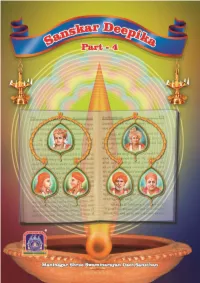
Sanskar Deepika Part 4 Sample Exam Paper
Shreejibapa Swamibapa Victory to Lord Shree Swaminarayan Sanskar Deepika Part - 4 Translation by His Divine Holiness Acharya Swamishree Purushottampriyadasji Maharaj Sants and Disciples Published by Maninagar Shree Swaminarayan Gadi Sansthan Shreeji-sankalp-murti Adya Acharya-pravar Dharma-dhurandar 1008 Shree Muktajeevan Swamibapa Suvarna Jayanti Mahotsav Smarak Trust Shree Swaminarayan Mandir, Maninagar Ahmedabad - 380 008 Gujarat, India SwaminarayanGadi.com © Copyright reserved with publishers ISBN - 978-93-81074-57-2 First Edition 1st July 2015 Copies 6000 Publication Cost: INR 25 Sponsor Subsidised Cost: INR 5 Graphics Shree Mukta Graphics Shree Swaminarayan Mandir, Maninagar Ahmedabad - 380 008 Gujarat, India Printing Shivkrupa Offset Printers 27 Amrut Industrial Estate Opp. Dudheshwar water tank Ahmedabad - 380004, Gujarat, India [email protected] SwaminarayanGadi.com SwaminarayanGadi.com SwaminarayanGadi.com SwaminarayanGadi.com Sanskar Deepika Part - 4 5 Contents Complete the Blanks Section A 07 Questions and Answers Section B 13 True or False Statements Section C 21 Context of Statements Section D 26 Match the Dates Section E 33 Match the Episodes Section F 35 Short Notes Section G 37 Sample Exam Paper 61 SwaminarayanGadi.com 6 Sanskar Deepika Part - 4 Key to Phonetics yt ā aarti ārti x t% pragat pragat% X t%hkanthi kant%hi z d$ upadati upad$ati Z d$h daadh i dād$hi ý n$ charan charan$ ¤ l% mangal aa mangal%ā SwaminarayanGadi.com Sanskar Deepika Part - 4 7 Syllabus Questions from this Booklet – 70% Amrut Bindu Part 2 – 20% Shree Hari’s Daily Chesta Pad (10 verses) – 10% Section A Complete the Blanks 1. Shree Swaminarayan Gadi is the Karan Satsang. -

Social Reformer Lord Shree Swaminarayan 1 Shree Swaminarayano Vijaytetram
Social Reformer Lord Shree Swaminarayan 1 Shree Swaminarayano vijaytetram Shree Nanarayandev Sahitya Series no - 42 In the memory of new temple of Lord Shri Narnarayan Dev Social Reformer Lord Shree Swaminarayan -: Author :- Dr. Swami Satyaprasad dasji -: Translator :- Ashish Raval By inspiration of Param Pujya 1008 Acharya Sri Kaushalendraprasadji Maharaj Published by Mahanat Purani Swani Sri Dharmnandan dasji Shree Swaminarayan mandir - Bhuj 2 Social Reformer Lord Shree Swaminarayan Auailable at Shree Swaminrayan mandir, Shri Narnarayan Dev Kothar- Bhuj Kutch Pin No. 370001 © Shree Swaminarayan Mandir - Bhuj All Rights reserved First :- Edition Copies :- 3000. Samvat :- 2066 Vaishakh Sud 5 Date :- 18 - 5 - 2010 Price :- Rs. 20 Typing Aad set by :- Dr. Swami Satyaprasad Dasji Printed in India at Shree Narnarayan Printing Press Shree Swaminarayan mandir - Bhuj Social Reformer Lord Shree Swaminarayan 3 Introduction Shree Swaminarayan Bhagwan before preaching any- thing used to put into practice. He set an example as to how to serve the parents by serving Dharmadev and Bhagtimata. He used to carryout service, study devdarshan and hearing katha. He did the saying and taught the students. Touring for 7 years he happened to come over Gujarat and met with Shree Ramand Swamiji and obtained Bhagwati Diksha and was handed over the charge of uddav sect. For the welfare of society he toured along with his followers but the public was in darkness and used to believe in blind faith and was totally ignorant of Sanskar. He thought that if their sufferings are removed and their mental health is improved it want listen to religious preaching so he started digging wealth and ponds for drinking water he stopped the violence carried out in the name of religions and set free the kings and his yes men from the clutches of vices and removed rotten ill customs. -
Philosophy That Grants All Equal Rights to Moksha
Satsang Pragna 3 Essay 1 Philosophy that grants all equal rights to Moksha ‘Aksharpurushottam Darshan’ is a philosophy of Parabrahman Swaminarayan. Philosophy means right understanding. The right of philosophy is not limited to the scholars of scriptures or to those who have proficiency in Sanskrit or English language. The doors of philosophy are open to everyone. A person, who can milk a cow without giving any sufferings to the cow, is considered the philosopher scholar of that task. A person who can cook pure, delicious, and digestible food is considered the master of cooking. A person might not have an education in school, college, or university, but that person might be an expert, scholar or philosopher in his/her own field. This is the fact, and there are thousands of examples in the world. Spiritual philosophy is similar and is called ‘Brahmavidya’. Brahmavidya is the key for ultimate happiness for all human beings. The doors of Brahmavidya are open for everyone. Everyone has equal right of Brahmavidya. Brahmavidya is far beyond the differences of egoistic racism, the differences of homemaker and ascetic, the differences of gender. Brahmavidya is for everyone. The real spirituality welcomes everyone equally. ‘Akshar Purushottam Darshan’ is the philosophy of Parabrahman Lord Swaminarayan that benefits all human kind. All aspirants have rights for the philosophy. It means it is theoretically accepted that this philosophy is worth achieving. In this article, we’ll learn more about this theory. Shri Hari has addressed ‘one who wishes to’, meaning Shri Swaminarayan Bhagwan has permanently left all the doors open for everyone with equal values without seeing the differences of cast, and is very clearly seen in these words Therefore, ‘Aksharpurushottam Darshan’ is the philosophy that is beneficial to everyone and is for the well-being of everyone. -

Swaminarayan Sect and Transition in Gujarati Society During the 19Th Century
RESEARCH PAPER History Volume : 3 | Issue : 5 | May 2013 | ISSN - 2249-555X Swaminarayan Sect and Transition in Gujarati Society During the 19th Century KEYWORDS Dr. DIlip Kataria Assistant Professor, Department of History, The M.S. University of Baroda, Baroda- 380002 ABSTRACT During the nineteenth century Social reform movement in the Gujarat was divided in to mainly two phase. During the first phase (1844-1880) the reformer emerging from the various upper casts and social groups inspired by the certain ides of west and reform the society on the basis of this ideas, but during second phase (from 1880 onwards) they challenged those ideas and norms which they thought were uprooting the indigenous cultural tradition. In this process they tried to synthesis the sects of clashing value system. During the first phase this reforming movement on western thought and the Swaminarayan sect on traditional way play important role in the reforming the Hindu society. The Swaminarayan movement was founded by the Sahajanand Swami in 1802. Sahjanand Swami championed the cause of women, convincing people to abandon the cruel practices of sati, female infanticide and dowry and even encouraged women's education. He inspired people to give up their addictions to tobacco, alcohol, gambling and other vices. Sah- janand Swami's influence spread through all stratas of society, from the elite classes to the lower classes, inspiring them to forsake their wayward lifestyles and adopt a morally pure, God-centered life. This paper sketches the role of Swaminarayan sect in reforming the Gujarati society in 19th century and also highlight relevance his idea which still playing major role in the economic and moral development of Gujarat Society. -

May 2008 Annual Subscription Rs. 60 228TH BIRTHDAY CELEBRATION of BHAGWAN SWAMINARAYAN 14 April 2008, Sarangpur
May 2008 Annual Subscription Rs. 60 228TH BIRTHDAY CELEBRATION OF BHAGWAN SWAMINARAYAN 14 April 2008, Sarangpur 1 2 3 1. Youths enact a drama on Bhakta Sagram’s transformation. Mandir in background. 2. Swamishri on stage. 3. Devotees in the celebration assembly. Photos: Sadhu Yogicharandas May 2008, Vol. 31 No. 5 CONTENTS FIRST WORD 1. Swaminarayan History Bhagwan Swaminarayan emphasized the Debate in Vadodara..............................4 Muktanand Swami defeats the Vedantacharya... importance of doing satsang for spiritual 2. On Life progress and happiness. At the same time he “I Am Sorry!” .......................................7 underscored the need to refrain from kusang, or Apologize before it is too late... bad company, in any form. In one of his dis- 3. Guru Parampara Yogiji Maharaj’s Austere Life.............11 courses he warns all devotees to avoid the four Fasting – a way of life... main types of kusang. The first are the 4. Personal Development Kudapanthis who dislodge you from spiritual Right Hand-Left Hand ........................14 Teamwork... vows (namely chastity) and make you morally 5. Bhajan History impure and corrupt. The second type of persons Orã Ãvo Mãrã Lerakhadã Laheri........15 are the Shaktipanthis who force you to eat meat On the banks of river Ghela... and drink alcohol and deflect you from dharma. 6. Vicharan Pramukh Swami Maharaj’s Vicharan ....16 The third category are the Shaktipanthis who 7. Inspiring Incidents propagate that God’s abode, his divine form and Living with Swamishri .......................18 the murtis of God’s avatars are false and thus Motivation and guidance... make you stray from the bhakti and upasana of 8.